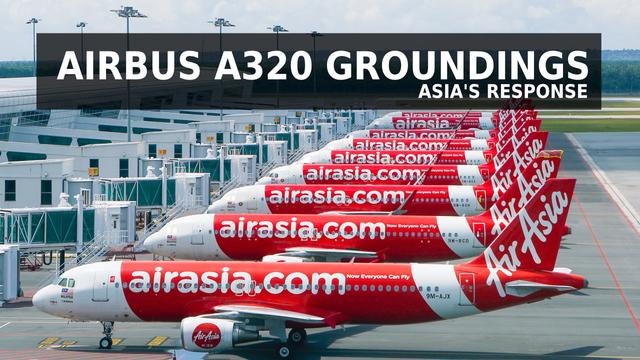
How the grounding of the A320 Family aircraft affected airlines throughout Asia, and how Airbus, Asia-based airlines, and the regions' aviation regulators addressed the situation.
On October 30, 2025, a JetBlue Airbus A320 was on what would have been a routine flight from Cancun, Mexico to Newark, New Jersey. During the flight, the aircraft - registered N605JB - experienced a sudden, uncontrolled descent. After diverting to Tampa, Florida, it was later reported around 15 passengers were injured and hospitalized as a result of the incident. Following an initial technical assessment by Airbus, it was found that solar radiation could affect the Elevator Aileron Computer (ELAC) on similar A320 Family aircraft. The assessment would lead to the grounding of nearly 6000 aircraft worldwide – including a significant amount of the popular narrowbody aircraft in Asia - to get the necessary safety checks and updates.
Airbus and EASA Advisories
Nearly a month after the incident involving the JetBlue A320 – which is still under investigation - Airbus issued an announcement on November 28 stating: “Analysis of a recent event involving an A320 Family aircraft has revealed that intense solar radiation may corrupt data critical to the functioning of flight controls.”
Airbus identified a “significant number” of A320 Family aircraft currently in-service that may be impacted, and the European aircraft manufacturer advised on implementing available software and/or hardware for the safe operation of the aircraft. Airbus further stated: “Airbus acknowledges these recommendations will lead to operational disruptions to passengers and customers. We apologise for the inconvenience caused and will work closely with operators, while keeping safety as our number one and overriding priority.”
Following Airbus' statement, the European Union Aviation Safety Agency (EASA) issued an Emergency Airworthiness Directive (EAD) on November 28 which identified the ELAC in question – B L104. The EASA advised airlines with aircraft that had the affected ELAC to update or replace them.
According to various reports, around 6000 Airbus A320 Family aircraft – including A319s, A320s, and A321s – were equipped with the system that could be affected by solar radiation. The advisory from the EASA would impact airlines from Asia – especially in Southeast Asia - where the A320 and A321 makes up the majority of their fleets. The impact would be felt in countries such as Malaysia, the Philippines, India, and Vietnam.
While the 14,000 passengers' travel plans were affected, the DOTr and the CAAP reported the progress of the ELAC updates on the affected aircraft – 19 from Cebu Pacific, 11 from Philippine Airlines. By the following day (November 30), all three airlines reported the checks and updates were completed on the affected aircraft.
Malaysia
Among the many airlines that heavily relies on A320/A321s, the Malaysia-based AirAsia Aviation Group (AirAsia) had a large exposure. Of its 257 aircraft fleet across its subsidiaries in Southeast Asia, a large majority of them – over 200 – are A320 Family aircraft.
AirAsia did not report the number of aircraft affected, though it did advise passengers on affected flights. In a statement following the issuance of the EAD, Group CEO Bo Lingam said the airline group would complete the necessary fixes within 2 days.
Lingam and AirAsia would report on November 30 that the fixes and updates were completed within 24 hours.
By November 30, Vietjet – along with Vietnam Airlines – completed the needed safety checks and updates.
Bamboo Airways and Vietravels stated their Airbus aircraft were not affected under the update requirement.
India
Around 350 aircraft were reported to be affected by the update requirement by India's Directorate General of Civil Aviation – including 200 operated by IndiGo and 113 by Air India/Air India Express.
Within the first day, it was reported that IndiGo completed the fixes on 184/200 aircraft, Air India with 69, and Air India Express with 17/25 planes.
Other operators of A320s including Star Flyer and ANA's subsidiary Peach Aviation reported none of their aircraft were affected.
Taiwan
According to Taiwan's Civil Aviation Administration, the local airline operators – including China Airlines, EVA Air, STARLUX, and Tigerair Taiwan – have a combined fleet of 67 A320 and A321 aircraft. Two-thirds (2/3) of the fleet were affected.
EVA Air and China Airlines reported normal operations though some software updates were made, while STARLUX reported their A321neos were not affected.
Tigerair Taiwan reported the completion of updates on its affected aircraft, as it adjusted its flight operations to accommodate the fixes.
Rapid, Clear Communication, Fixes
Within days, airline maintenance workers – collaborating with Airbus and their local aviation regulators - from around the world made the necessary fixes and the aircraft were back in immediate operation. Aviation regulators and airlines issued updates of the work done to the traveling public.
The travel plans of thousands of passengers across Asia and many more around the world were affected by what was the largest single-grounding of Airbus aircraft. Though we do have to give credit to Airbus for identifying the potential technical flaw before anything worse than the JetBlue flight incident happened.