Already served by a dual airport system, Shanghai may soon get two more airports. The Jiaxing Nanhu Airport in nearby Jiaxing recently opened to be a regional cargo hub, while a new airport is being planned to be built in Nantong.
Along the eastern coast of Mainland China, Shanghai is one of the handful of global cities currently served by a dual-airport system. Comprising of the main international gateway Pudong International Airport and the city's former hub Honquiao, the passenger traffic at both airports combined surpass 100 million annually. Already one of the busiest cities in terms of air passenger traffic, there are two new additional airport projects currently in the works. Recently opened is the Jiaxing Nanhu Airport – a military air base that will become a regional logistics hub. Another airport project is currently getting started in the nearby coastal city of Nantong.
Jiaxing Nanhu Airport – The New Regional Hub
Image: Artist depiction of Jiaxing Nanhu Airport (Credit: jiaxingren.com)
Located 100km southwest of the center of Shanghai, and 8km outside the city center of Jiaxing, is the former exclusive military air base that will become a new logistics hub for the Yangzte River Delta region – the Jiaxing Nanhu Airport. Opened on December 26, 2025, the new airport will have a “cargo-first, passenger supported” model.
Behind the Jiaxing Nanhu Airport project is Shanghai-based logistics company YTO Express, the parent company of YTO Cargo Airlines. At present, its air freight operations are based at Hangzhou Xiaoshan Airport. While the Yangtze River Delta region is a major economic hub for China, the area lacked an airport dedicated for cargo transport. Following fellow Chinese logistics company SF Express in developing its own dedicated air cargo hub – the first in China - at Ezhou Airport in Hubei, YTO Express plans to turn Jiaxing into its own hub.
Image: YTO Express Airlines Boeing 757 (Credit: Wikimedia Commons)
As part of its expansion plans, YTO Express entered into an agreement with the local Jiaxing City government in 2018 to convert a 96km area of the aviation facility into its own hub. YTO Express' investment is worth over USD $1 billion, which the company will build a 600,000sqm facility to handle an initial air cargo traffic of over 1.1 million tonnes annually.
Speaking about the role of the Jiaxing Nanhu Airport for YTO Express and the surrounding area, David Su, Chairman of YTO Cargo Airlines was quoted in cargofacts in 2018 saying: “From the perspective of coverage, the three-hour flight circle of Jiaxing Airport can fully cover the domestic core urban agglomerations such as the Yangtze River Delta, the Pearl River Delta, the Beijing-Tianjin-Hebei and the Chengdu-Chongqing Economic Belt.”
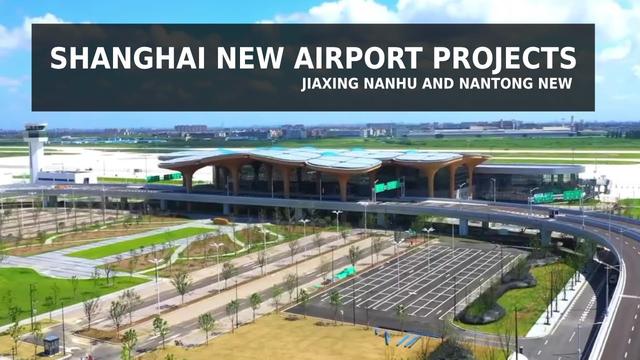
The Jiaxing Nanhu Airport features a 3,400m 4E class runway. 56 aircraft stands are available – including 30 for widebody aircraft. A 25,900sqm passenger terminal features a design inspired by the official flower of the city of Jiaxing – the azalea. The full completion of the airport is scheduled to take place in 2035, which will have a capacity to serve over 4 million passengers and 1.2 million metric tonnes of cargo per year.
As the Jiaxing Nanhu Airport is expected to complement the bigger air hubs of Pudong and Honquiao with an initial 12 domestic routes to cities including Beijing, Shenyang, Harbin, Xi'an, Chongqing, Chengdu, Kunming, Harbin, Shenzhen, Guangzhou, Changchun, and Haikou. International cargo operations are expected to be launched to the US, UK, Canada, South Korea, and Germany.
Nantong New Airport – Proposed Airport Project
While the Jaxing Nanhu Airport will become the Yangtze River Delta's new cargo hub, the operator of Shanghai dual air hubs is leading the development of a new airport in Nantong located over 100km north of Shanghai.
Recently in August 2025, the Shanghai Airport Group and the Nantong Urban Construction Group formed a joint venture to develop the new airport - the Shanghai-Jiangsu Nantong New Airport Construction Investment company (Nantong New Airport).
Under the construction plan by the Shanghai Airport Group, the airport will be located on land 120km from Shanghai. Featuring 2 runways, the future Nantong New Airport will designed to handle 40 million passengers to start before reaching its full capacity of around 80 million.
According to a report from Yicai Global, Shanghai-based China Eastern, China Southern, and Air China have plans to set up bases at the Nantong New Airport.
From Shanghai, there will be a rail connection through the Shanghai-Suzhou-Nantong railroad. As the first phase of the project is in the works between Hongquiao and Nantong, the second phase is scheduled for completion in 2027. Through the rail link, Nantong New will be connected with the other two Shanghai air hubs.
The Future of Shanghai's Airport System
Shanghai is one of the handful of cities currently served by a Dual Airport system. With the additional airports, the city will become among the few served by multiple hubs such as London and New York.
Already Shanghai Pudong is one of the busiest airports in the world (+76 million in 2024). Combined with Hongquiao (+48 million, 2024), Shanghai's air hubs already serves over 100 million per year. Unlike the two current air hubs, Jiaxing Nanhu and Nantong New Airport projects will be located at least 100km away from Shanghai.
While it may not seem far for those living in Shanghai, China's new airports are connected via high speed rail to other nearby cities. New air hubs in the country such as Beijing Daxing serves not just Beijing, but is also considered a primary air hub for the city of Tianjin along the Chinese east coast – 100km away.
It will be no different with Jiaxing Nanhu and Nantong New, which will also have rail links to Shanghai, along with the nearby cities such as Hangzhou, Suzhou, and Jiaxing. Jiaxing Nantong as a logistics hub will allow the other air hubs to focus on regularly scheduled passenger traffic.
.png)
.png)
_-_MSN_29217_-_VGHS.jpg)