Features
AirAsia and the Airbus A220 - A320 Replacement
Written by Jeffrey Teruel | Published on May 08, 2026
Features
Written by Jeffrey Teruel | Published on May 08, 2026
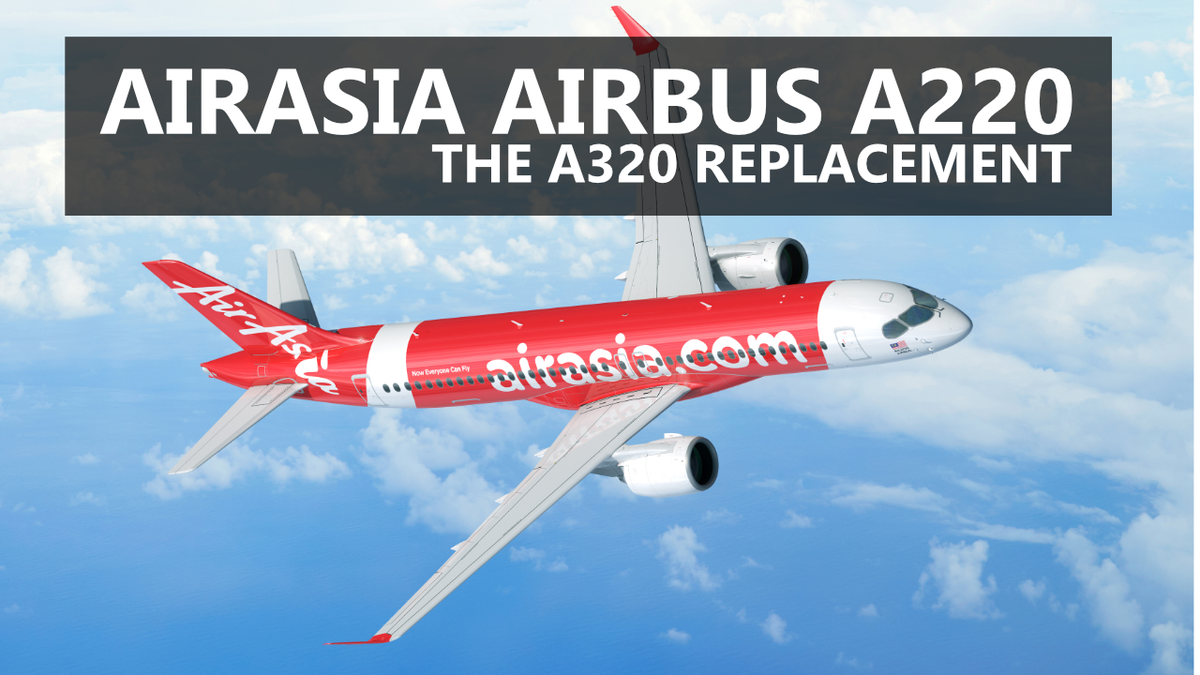
After more than a decade, AirAsia is ordering 150 Airbus A220s - an aircraft that the airline group had been interested in when it was the Bombardier CSeries.
Recently, Airbus announced that AirAsia has ordered 150 A220-300s. Scheduled to be delivered from 2028, the Malaysia-based airline group also has options for 150 more which can take the total up to 300. What AirAsia is ordering is a new, high-capacity variant of the A220-300 which will have a capacity for 160 passengers. It happens to be an aircraft the airline group has been keeping an eye on for well over a decade. Now, the AirAsia Group is going through with an order for A220s which will be a part of its future plans.
From the CSeries to A220
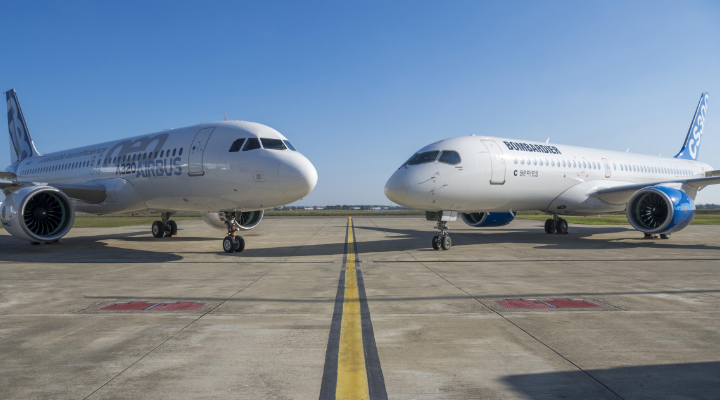
Image: Airbus A320neo and A220 (with former Bombardier branding). Credit: Airbus.
Today, the A220 is marketed by Airbus as a smaller, narrowbody aircraft than its popular A320/A321 family capable of operating at smaller, regional airports. Developed and launched by Canada-based Bombardier as the CSeries in 2008, two variants were introduced – the first variant and longer-range CS100, and the higher-capacity CS300. The first CS100 took to the skies in 2013, followed by the first commercial passenger flight by SWISS three years later on July 15, 2016. Bombardier had its focus on the lucrative market of regional flight operations especially in the US, though the program was not getting much sales. It was not until Airbus secured a majority share in the CSeries program in 2018 when the number of orders for the aircraft would get a much needed boost.
Airbus would rebrand the manufacturing operation of the CSeries under a new name: Airbus Canada Limited Partnership (ACLP), and following its aircraft naming conventions it would take on a new name: the A220. The CS100 become the A220-100 and the CS300 is now known as the A220-300. Production still takes place at the original facility at Mirabel, Canada. A separate facility would later be opened in Mobile, Alabama for deliveries to US-based customers such as Delta, JetBlue, and Breeze Airways.
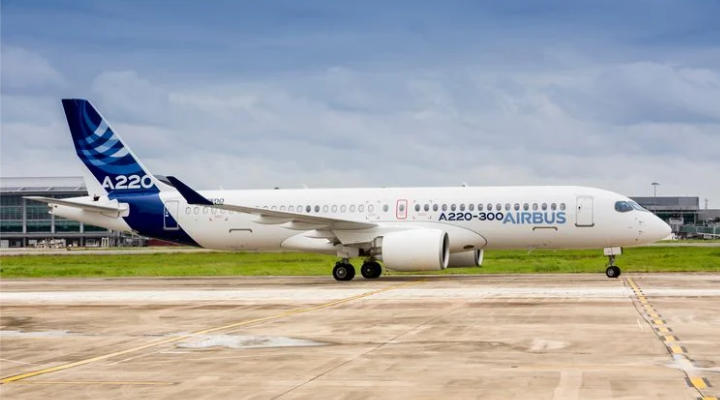
Image: Airbus A220-300. Credit: Airbus.
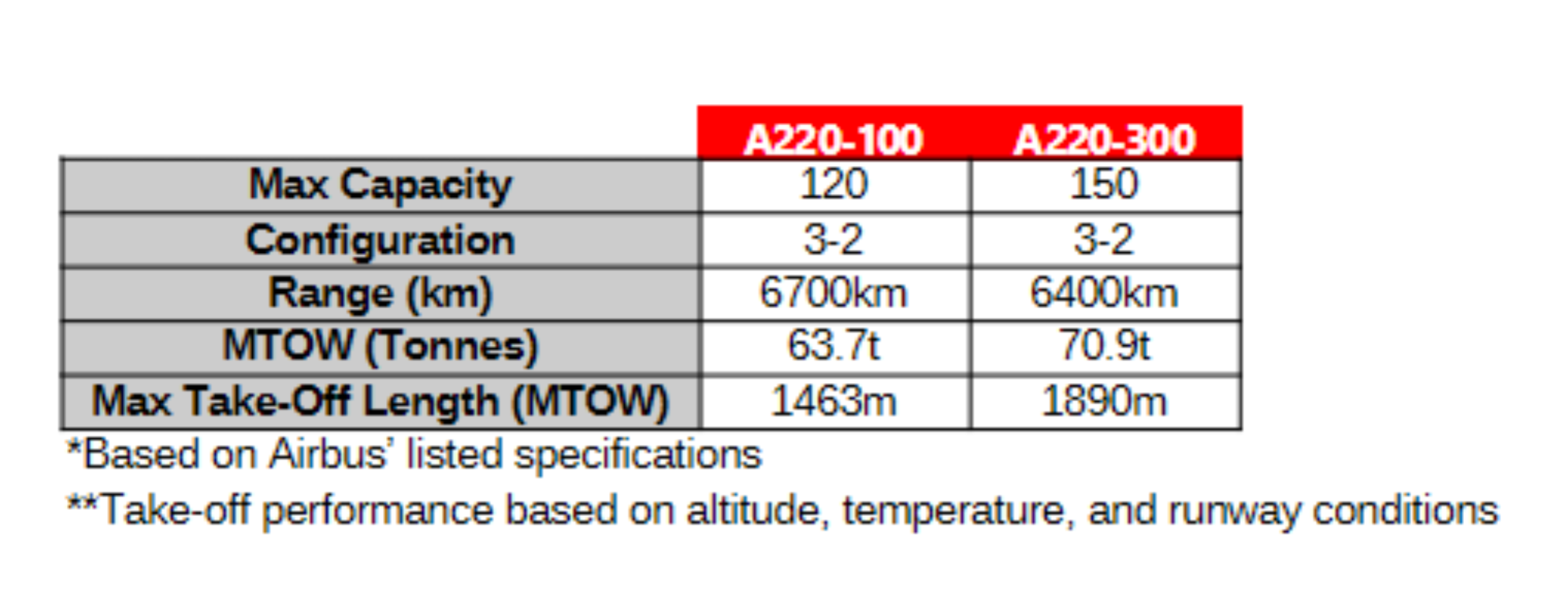
The A220 is a small, narrowbody aircraft with a capacity between 100-150 seats and a range of up to 6,700 kilometers. The A220-100 has the smaller maximum capacity of 120 but with the longer range of the two variant. The A220-300 is the bigger, higher-capacity variant capable of accommodating up to 150-160 passengers. While a 2-2 seat configuration can offer a premium experience, most higher density and Economy configurations are 2-3 (left-right).
AirAsia’s Replacement of Older A320s
While AirAsia will be the launch customer of the 160-seat A220-300 with this landmark order, the airline group has had an interest in the A220 going back to the early 2010s. The 160-seat variant had been a part of the discussions between the airline, Bombardier, and the CSeries program. AirAsia would eventually decided to stay with an A320 fleet at the time, though the idea to order the aircraft remained. During the 2012 Farnborough Airshow, AirAsia CEO Tony Fernandes recognized the potential of the CSeries and was quoted in a report by FlightGlobal published in November 2012 saying the aircraft can “get into a lot of airports to which we currently do not have access.” Fernandes added that the onus was on Bombardier to prove that the operating cost of the CS300 in a high-density configuration “makes sense” for AirAsia.
Fast forward 14 years later to 2026, the 160-seat A220-300 is now going to be reality. While being able to accommodate more passengers, Airbus stated that these aircraft – scheduled to be delivered from 2028 – will also feature additional overwing exits on each side. According to AirAsia, the airline group plans to use the aircraft across ASEAN and the Asia-Pacific, freeing up the larger A320/A321s for longer, mid-haul routes and the A330s for the long-haul flights into Europe, Australia, and North America.
AirAsia on the A220: “The A220 is a natural strategic fit within the Group’s multi-gauge fleet. It will provide the flexibility to easily meet demand, allowing AirAsia to aggressively increase flight frequencies on existing routes, giving guests the convenience of multiple daily departures and better connectivity windows, supporting Fly-Thru traffic."
Being the launch customer of the 160-seat A220-300, AirAsia is already looking beyond this order for an even bigger variant – an A220-500 – which the airline sees it would help replace its older A320s.
AirAsia on a future A220-500: “The A220 is a highly scalable product, offering a seamless path to the future A220-500 variant to meet evolving capacity needs and successor to the aging A320s in the similar capacity range of 180+ seats. Powered by state-of-the-art engine technology, it is among the most efficient aircraft in its class, offering an optimal balance of range and capacity. It is approximately 20% more fuel efficient and produces about 20% less emissions compared to the A320ceo.”
While smaller than the A320, the A220’s technical specifications can back up these statements. The A220-300 has a comparable range to the A320neo with a lighter Maximum Take-Off Weight (MTOW). AirAsia will most likely not push these aircraft to their maximum capabilities and reduce amenities, though they can do the sub-4 hour flights that the A320 does today. The aircraft would enable AirAsia to better respond to demand, and serve smaller airports that can’t accommodate the A320/A321s – opening new routes for the airline group across ASEAN.
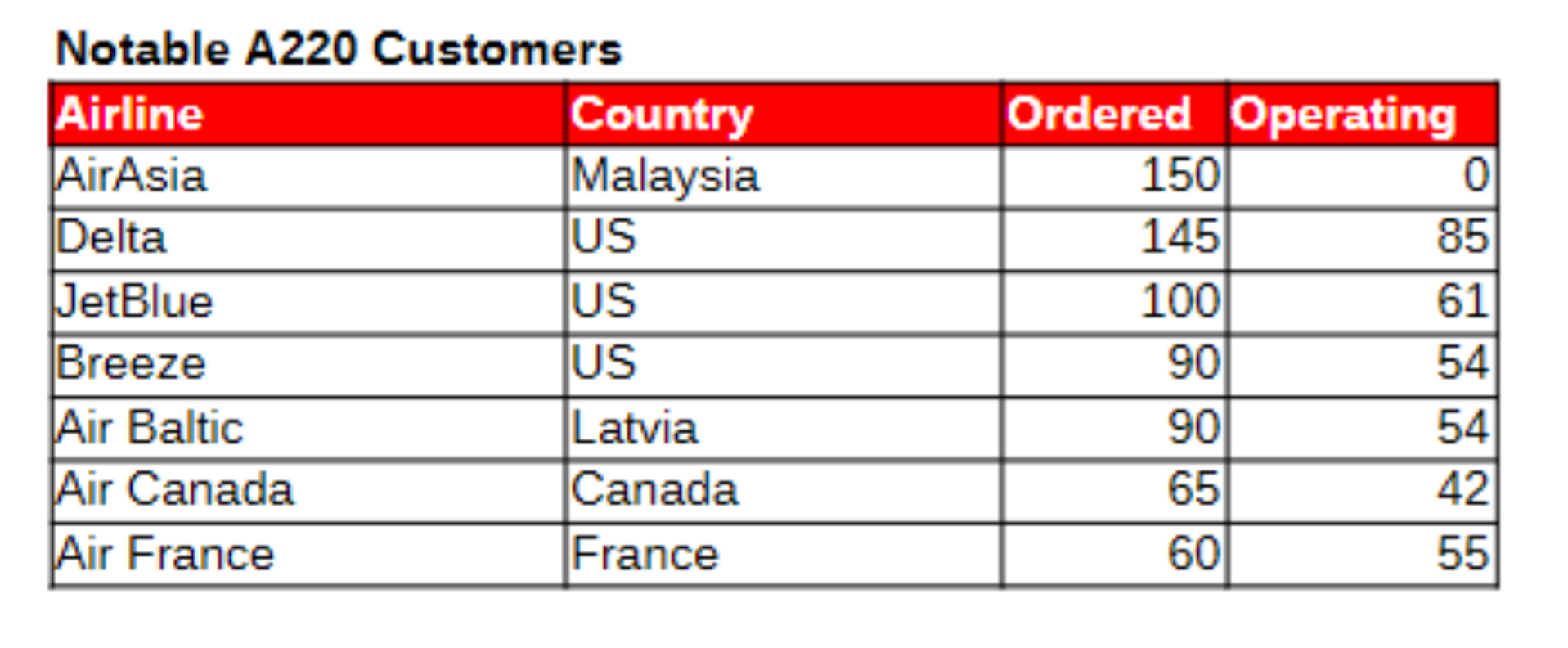
The newly announced order by AirAsia for the 150 A220s brings the total number of aircraft ordered for the former CSeries program to over 1000. Already a major customer for Airbus, AirAsia is now the largest customer of the A220 surpassing Delta with its 145 total. Around 500 A220s are already in operation around the world with Delta (85), JetBlue (61), Air France (55), and both Breeze and Air Canada (54 each) with the largest fleets of the small, narrowbody jets.
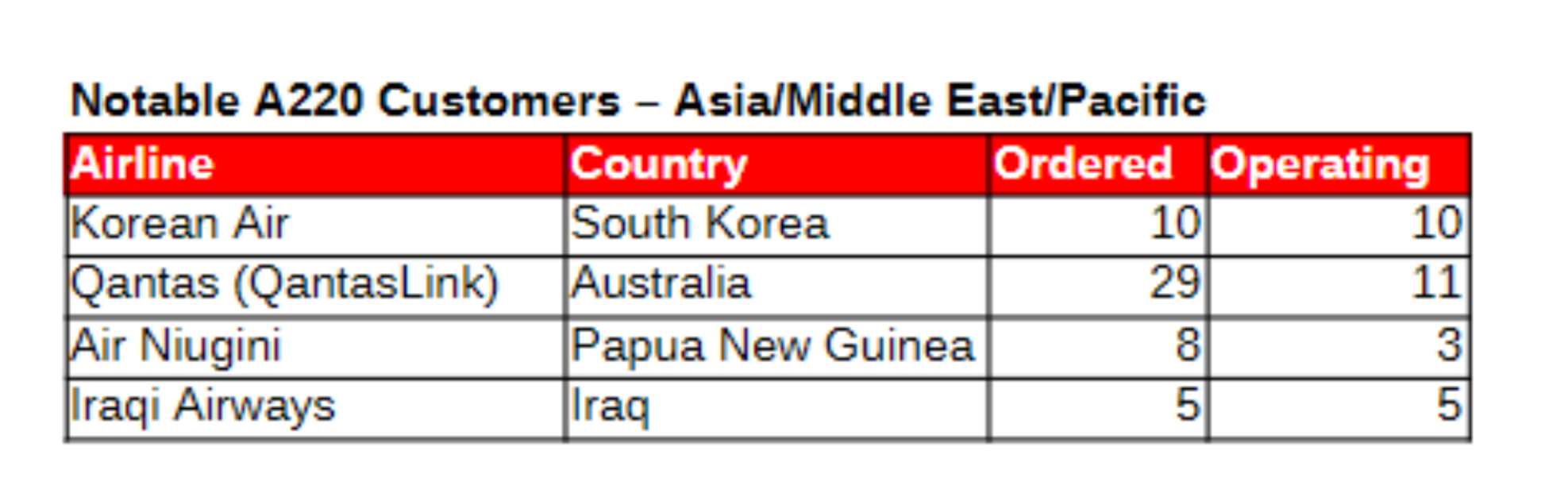
In the Asia-Pacific, Qantas was the biggest customer with 29 total orders – 11 of which have already been delivered and operating with its subsidiary QantasLink. Korean Air operates 10 -300s, Air Niugini’s 3 -300s, and Iraqi Airways with its 5 -300s.
AirAsia’s A220s vs Scoot’s E2s
It can be argued that a contributing factor that may have pushed AirAsia to finally go through with this order was Scoot’s introduction of the Embraer E190-E2 (E2) to its fleet. Since taking on its first E2 in the spring 2024, the budget subsidiary of Singapore Airlines has opened new routes from Singapore using the small, narrowbody jets to cities in ASEAN such as Iloilo, Philippines; Hat Yai, Thailand; Labuan Bajo, Indonesia; and both Miri and Sibu in Malaysia. Unlike Scoot, AirAsia operates beyond Singapore with hubs at major cities in ASEAN such as Jakarta, Kuala Lumpur, Manila, and Bangkok. The A220 does open up some possibilities of new routes not currently served by AirAsia from these hubs.
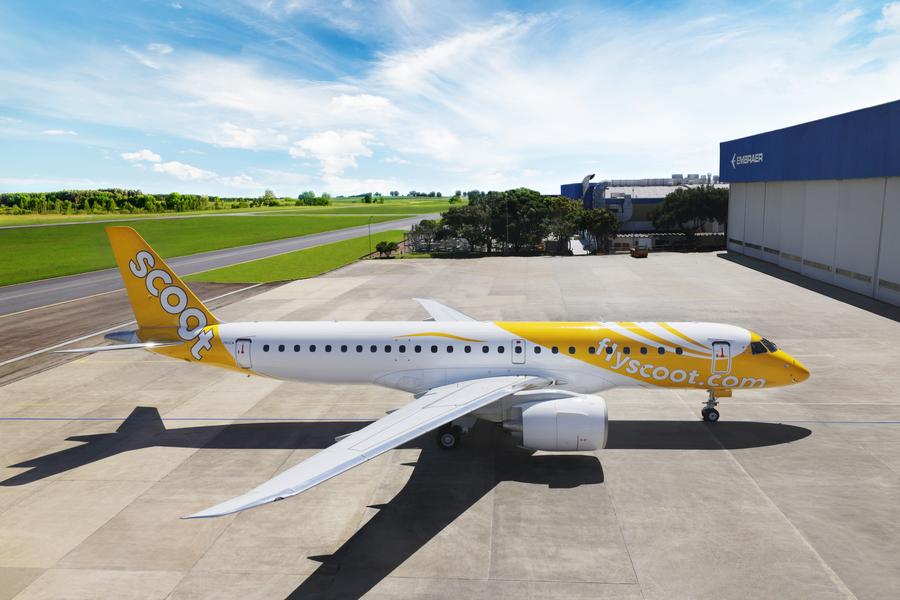
Image: Embraer E190-E2. Credit: Scoot.
Between the A220-300 and the E2, the E2 is the smaller, lighter aircraft that can both operate on shorter runways yet with a comparable range. Passengers will notice the 2-2 configuration on the Scoot E2, while it is anticipated that AirAsia’s 160-seat -300s will have a 3-2 configuration – just one less column of seats than the familiar A320. Scoot’s E2s serve as a feeder to the network of connections via the Singapore Airlines Group hub at Singapore. Meanwhile, the AirAsia network is more spread out than the one-hub operation for Singapore Airlines/Scoot. AirAsia aims to replace the older A320s, potentially open new point-to-point routes across ASEAN it currently does not serve, and operate with more capacity while keeping its costs down.
For the pilots of both airline groups, the E2 and A220s don’t have same pilot rating of the A320 Family. While there will be a learning curve for pilots who train to fly the E2 and soon the A220s, these aircraft are part of both airlines’ fleet diversification plans and are an investment to enhance their overall group network. These aircraft can be used to destinations that already accommodate A320s such as Caticlan in the Philippines – the main gateway to the resort island of Boracay – Miri and Sibu in Malaysia, and Koh Samui, Thailand. Though some airports to resort destinations in the region such as Siargao and other smaller airports in the Philippines do require much needed upgrades.These upgrades such as the lengthening their runways and the expansion of airside facilities will need to be done before AirAsia or Scoot can consider launching new flights to those destinations.
AirAsia’s Fleet Diversification
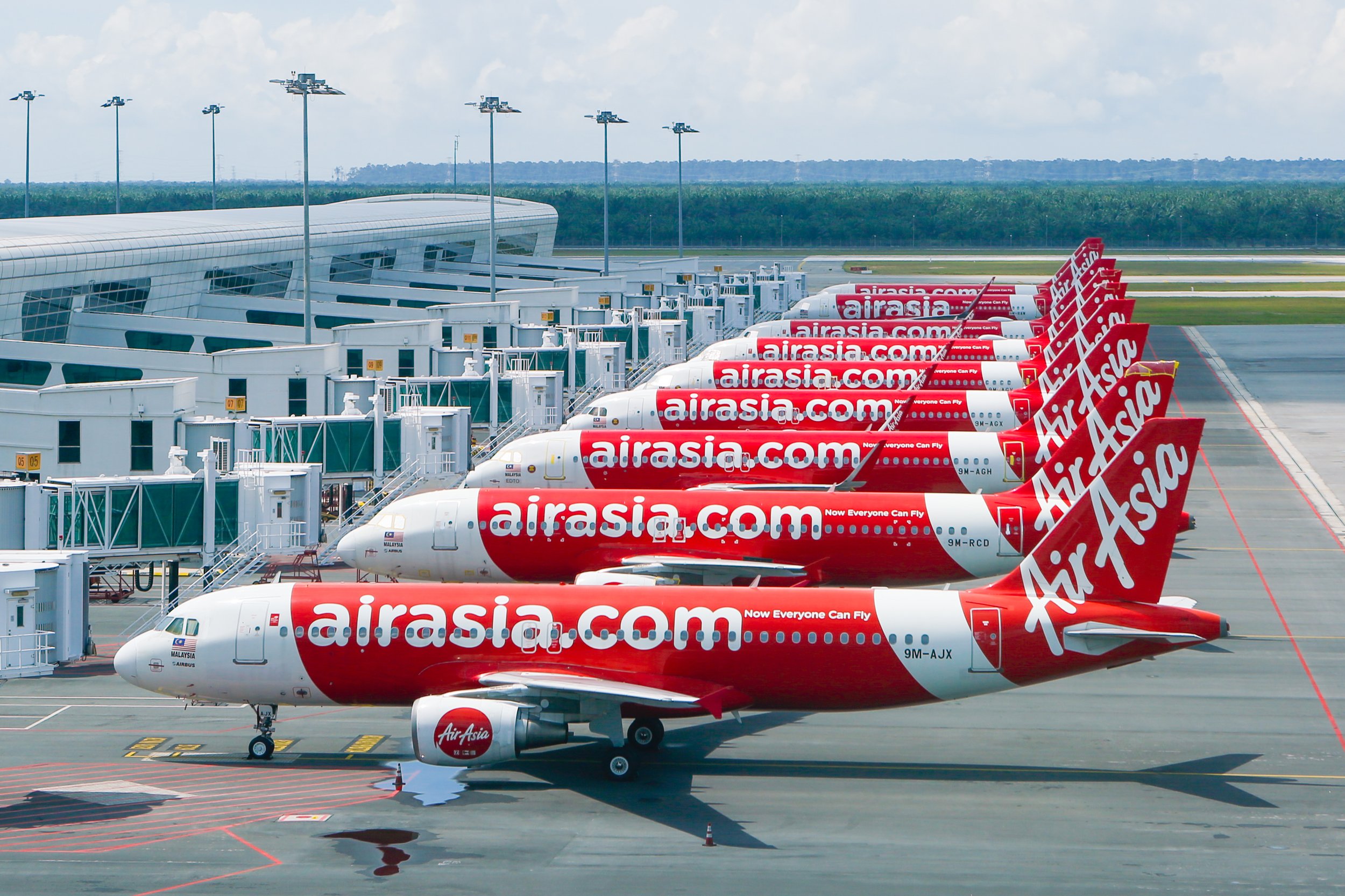
Image: AirAsia A320s parked at the gates at the Kuala Lumpur International (KLIA) Terminal 2. Credit: AirAsia
After Tony Fernandes bought AirAsia for just one Malaysian Ringgit, the A320 has been the backbone of its fleet for two decades. It has been the reliable workhorse of the AirAsia Group to bring low fare travel across Southeast Asia. So it might come to a shock that Fernandes and the very airline he helped grow is now considering a replacement of the 180-seat A320s. In the ever changing landscape of global aviation, complacency is not a great strategy – the market and factors such as rising fuel costs come to play. While the A320 is a primary workhorse now, AirAsia is eyeing the A220 as its successor.
To full-fill this need, Airbus has a smaller aircraft type – the A220 – which was acquired from the former Bombardier CSeries program. Still a Canadian product, Airbus-backing brings credibility to the program when it comes to selling the jets to its loyal customers. It may not have been the right aircraft for AirAsia when it was introduced, but after more than a decade AirAsia is now committed to the A220.
The A320 family is still going to be a big part of the future of AirAsia through the bigger A321neo. The airline still has a backlog of over 300, mostly A321neos that have yet to be delivered. In addition, the nearly 30 A320neos delivered from the late 2010s still have around a decade of service. But now AirAsia is looking towards a future where the A220 takes over the role within its fleet long-held by the A320.