Features
Phu Quoc Airport Expansion - Partners with Singapore's Changi Airport
Written by Jeffrey Teruel | Published on May 05, 2026
Features
Written by Jeffrey Teruel | Published on May 05, 2026
The operator of the Phu Quoc International Airport is partnering with Singapore's Changi Airport to support its plan to turn the southern Vietnamese island into a regional air hub.
When planning to travel to Vietnam, it is often that the major cities of Hanoi and Ho Chi Minh City that most visitors will enter the country through first. Though in recent years, other cities such as Da Nang have seen a growth of visitors. Then there are other attractions such as Phu Quoc – an island located off the coast of Southern Vietnam. As more visitors discover Vietnam’s “Pearl Island”, the Phu Quoc International Airport has seen a growth of its international route network. Recently, work has started to transform the island’s modest airport into a premier regional air hub. To do so, the operator of Phu Quoc’s airport is teaming up with the operator of the what many consider is the world’s best airport – Singapore’s Changi Airport Group (CAG).
The Phu Quoc International Airport
When all the expansion work is completed, the long-term capacity of Phu Quoc’s airport can be up to 50 million passengers annually. The airport will be transformed with a ICAO Level 4E classification capable of handling the world’s biggest aircraft such as the Boeing 747-8 and the Airbus A380.
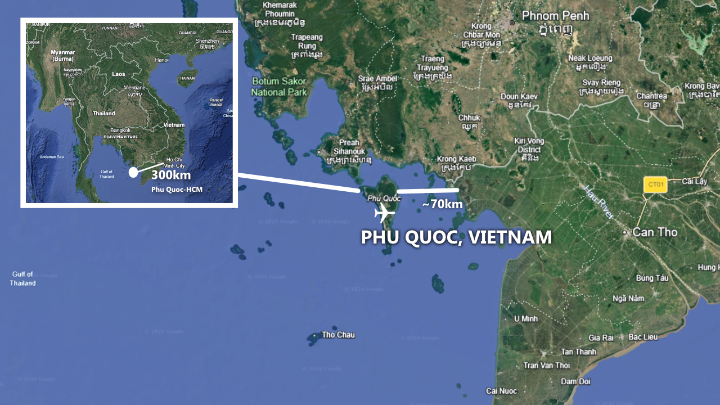
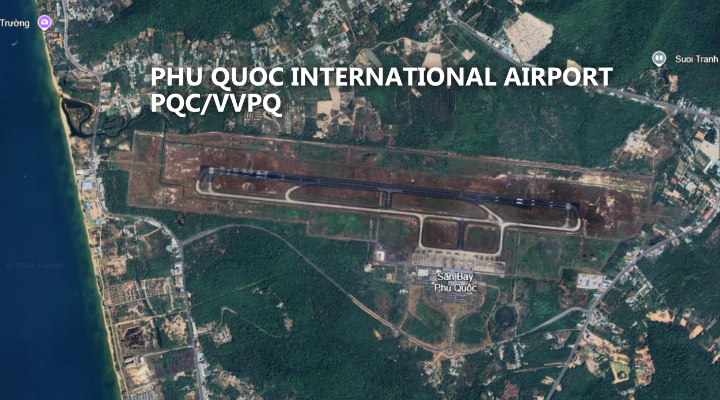
Opened in 2012, the current Phu Quoc International Airport is the primary airport serving the island of Phu Quoc just off the southern Vietnamese coast. The island is around 70 kilometers west from the closest point from Vietnam and 300 kilometers west from Ho Chi Minh City. When looking for the island on a map, it is closer to the southern coast of Cambodia than it is to Vietnam. Its overall land area covers around 580skm (square kilometers) which makes it smaller than Singapore’s 744skm. Though Vietnam’s Pearl Island is small, it has seen a growth of visitors from other parts of Vietnam and beyond. As the island welcomes more visitors, more attention will come as Phu Quoc will host the upcoming 2027 Asia-Pacific Economic Cooperation (APEC) Forum.
Back at the Phu Quoc International Airport, the one-runway facility served around 6 million passengers arriving and departing on a combination of domestic and international flights last year – well above its designed capacity of around 4 million. The airport serves as a hub for Vietnam Airlines, Vietjet, and a new locally-based airline Sun PhuQuoc Airways which has made headlines with its own ambitious growth plans. In addition to the Vietnam-based airline operations, major foreign airlines operating flights to/from Phu Quoc include AirAsia, China Eastern, Korean Air, STARLUX, and Scoot. While there are limited and charter flights to Europe and Russia, most of the regular passenger flights are to destinations within Asia including Korea, China, Malaysia, and Singapore.
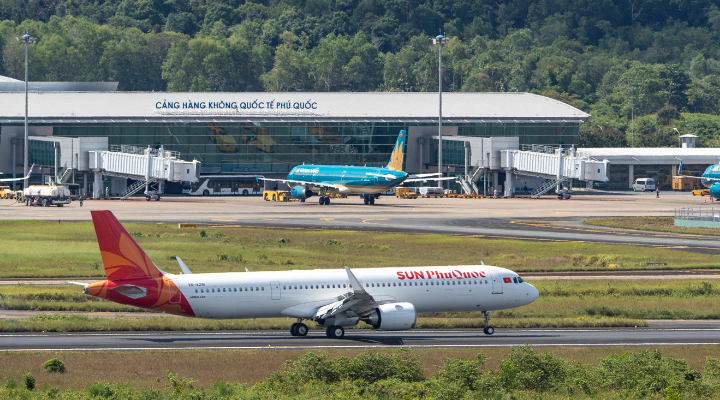
Image: Sun Phu Quoc Airways A320 on the runway with a Vietnam Airlines aircraft parked at Phu Quoc Airport.. Credit: Sun Group
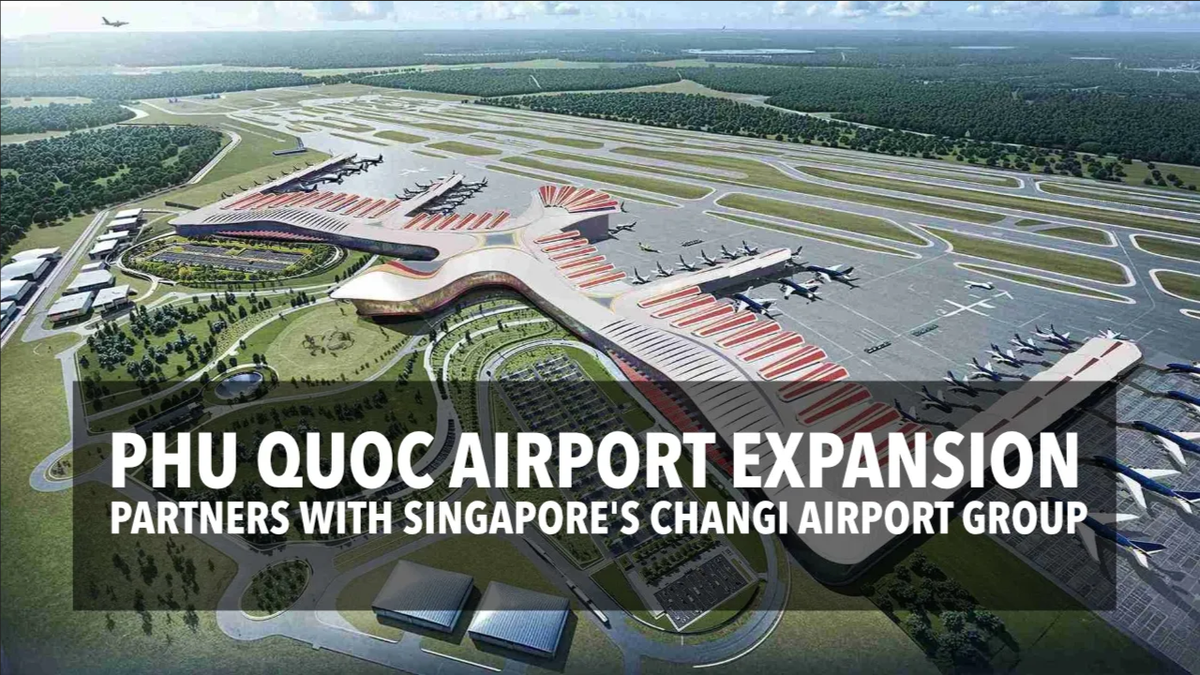
Recently, Vietnam’s government and The Sun Group – the airport’s current investor– is looking to expand the airport’s operation to become a bigger air hub. In June 2025, Vietnam’s government approved the airport expansion plan worth around VND 22 trillion (~USD $835 million) which includes the construction of a second runway and a bigger passenger terminal building. When all the expansion work is completed, the long-term capacity of Phu Quoc’s airport can be up to 50 million passengers annually. The airport will be transformed with a ICAO Level 4E classification capable of handling the world’s biggest aircraft such as the Boeing 747-8 and the Airbus A380.
Sun Group and the Changi Airport Group
The Sun Group signed a strategic cooperation agreement with the Changi Airport Group’s foreign investment and consulting division Changi Airports International (CAI) that will put CAI in charge of the operations of the Phu Quoc Airport. Taking on the responsibility of the operations of the airport, CAI will help the Sun Group implement Vietnam’s plan for the country’s future southern air hub.
Along with the approval of the Phu Quoc International Airport expansion plan in 2025, Vietnam-based conglomerate Sun Group became the main investor for the airport through a subsidiary named the Sun Airport Corporation. Later in March 2026, the Sun Group signed a strategic cooperation agreement with the Changi Airport Group’s foreign investment and consulting division Changi Airports International(CAI) that will put CAI in charge of the operations of the Phu Quoc Airport. Taking on the responsibility of the operations of the airport, CAI will help the Sun Group implement Vietnam’s plan for the country’s future southern air hub.
The expansion plan will see the growth of the airport’s footprint from the current 884 hectares to over 1000 hectares (1050 hectares). It will include an expansion of the current runway from the current 3,000 meters to 3,500 meters, and the construction of the second parallel runway with a length of 3,300 meters. The airport will have over 100 aircraft parking positions – 45 of which with passenger jet boarding bridges.
At the centerpiece will be the new Terminal 2, featuring a phoenix-inspired design. Though it will be the use of technology along passenger touchpoints such as check-in and boarding which will make it Vietnam’s first “smart airport.” Security procedures will be integrated with facial recognition, biometrics, and integrated digital data to reduce the inspection time to 15-20 seconds. The airport will also feature a modern baggage system and an underground refueling system.
Image: Artist depiction of exterior and interiors of new Terminal 2 Phu Quoc International Airport. Credit: Sun Group
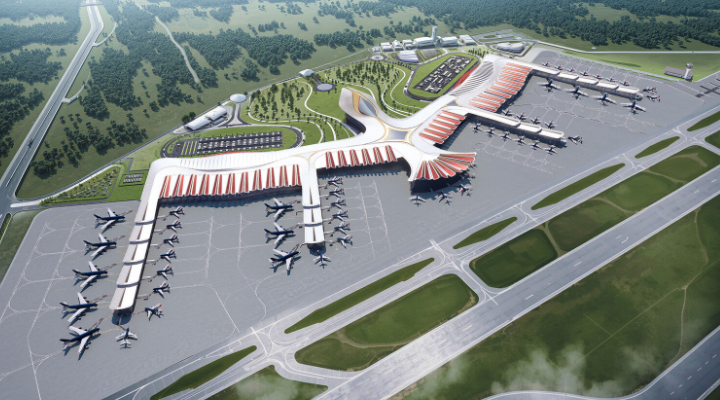

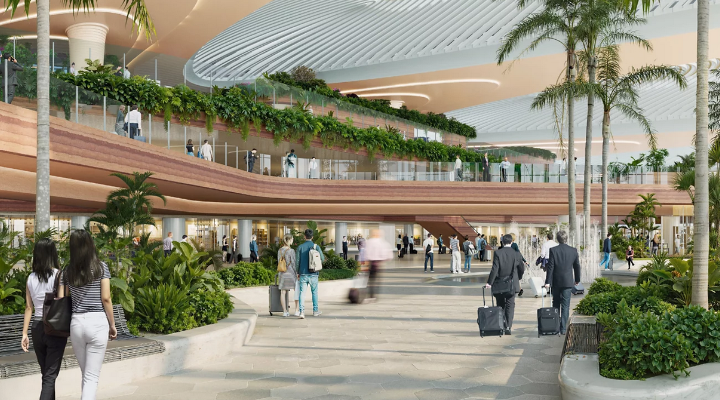
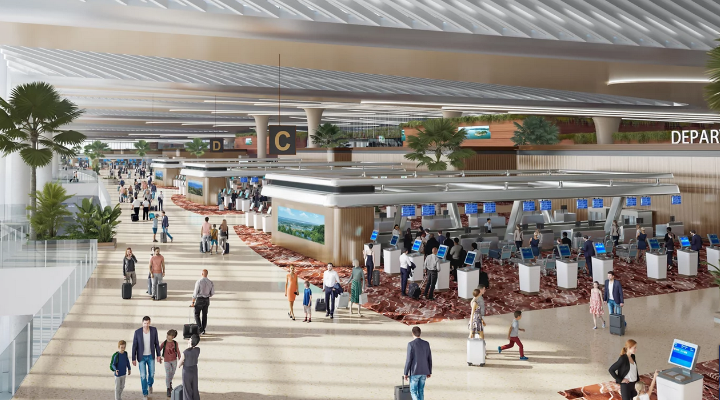
In addition to the new Terminal 2 construction, work is also taking place for an 8,500 square meter VIP Terminal. Scheduled to be opened ahead of the APEC 2027 meetings, it is designed to handle chartered flights of up to 300 passengers and heads of state during the event in 2027.
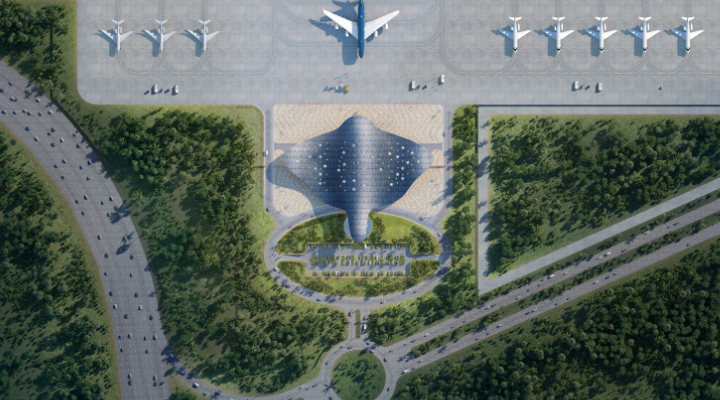
Image: Artist depiction of VIP Terminal, Phu Quoc International Airport. Credit: Sun Group
The VIP Terminal is part of the first phase of the project which will be completed before APEC 2027. Upon the completion of the first phase, the airport will be able to accommodate around 18 million passengers. Phu Quoc’s airport expansion plan will enable further expansion to serve up to 50 million passengers and 50,000 tonnes of cargo per year by 2050.
Beyond APEC 2027
The Sun Group is investing heavily into the island's aviation industry. Sun PhuQuoc Airways has made recent headlines with the launch of new international routes to cities such as Taipei and Seoul, and an order for up to 40 Boeing 787 Dreamliner aircraft announced this past February. Those newly ordered widebody aircraft are expected to serve long-haul destinations from the expanded airport at Phu Quoc.
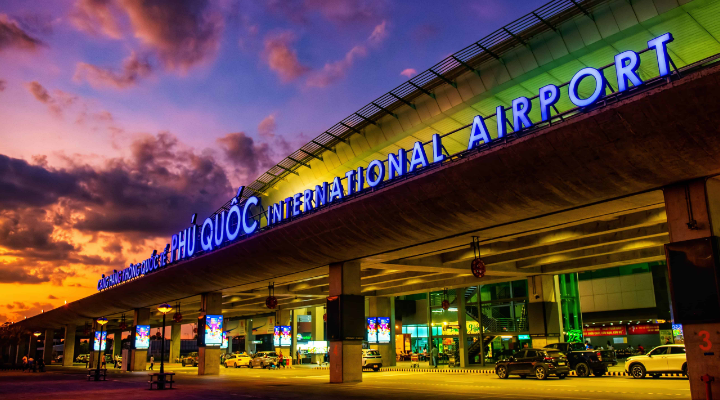
Image: Departure entrance at Phu Quoc International Airport. Source: Wikimedia Commons
With Phu Quoc being the host of the APEC 2027 meetings, the expansion of the Phu Quoc International Airport has been a priority project for Vietnam’s government. After construction work started in the summer of 2025, the first phase is expected to be completed within an 18-month timeline. The work for the expansion project has taken place while regular operations continue at the airport.
According to a report from the Vietnam-based outlet Vietnam Plus, as of March 2026 around 58% of the base layer for the second runway has been completed. 85% of the structural framework of Terminal 2 has been completed, while the same work has already been completed for the VIP Terminal. It is expected that some of the work – including the completion and opening of the second runway – will be done by June of this year.
The expansion work at the Phu Quoc International Airport is one of several major infrastructure projects related to aviation taking place in Vietnam. While Phu Quoc is being positioned to be a major regional air hub, Ho Chi Minh City’s new airport – the Long Thanh International Airport – is expected to be opened during the fourth quarter of this year.
Beyond the upcoming APEC summit, Vietnam is positioning its Pearl Island Phu Quoc as not just a premier resort destination in Southeast Asia, but also as a regional air hub. Along with the investment into the Phu Quoc International Airport, the Sun Group is also making major investments into its two airline brands – private charter company Sun Air sand Sun PhuQuoc Airways. Between the two airlines, Sun PhuQuoc Airways has made recent headlines with the launch of new international routes to cities such as Taipei and Seoul, and an order for up to 40 Boeing 787 Dreamliner aircraft announced this past February. Those newly ordered widebody aircraft are expected to serve long-haul destinations from the expanded airport at Phu Quoc.
The Sun Group is investing heavily in the aviation industry of Phu Quoc which is a small island that is welcoming more visitors. To accomplish its ambitious expansion plans, the Phu Quoc Airport operator has partnered with the Changi Airport Group to turn what is currently a modest airport operation to an emerging destination into a regional air hub.