Features
AirAsia Philippines - Potential Suspension
Written by Jeffrey Teruel | Published on June 04, 2026
Features
Written by Jeffrey Teruel | Published on June 04, 2026
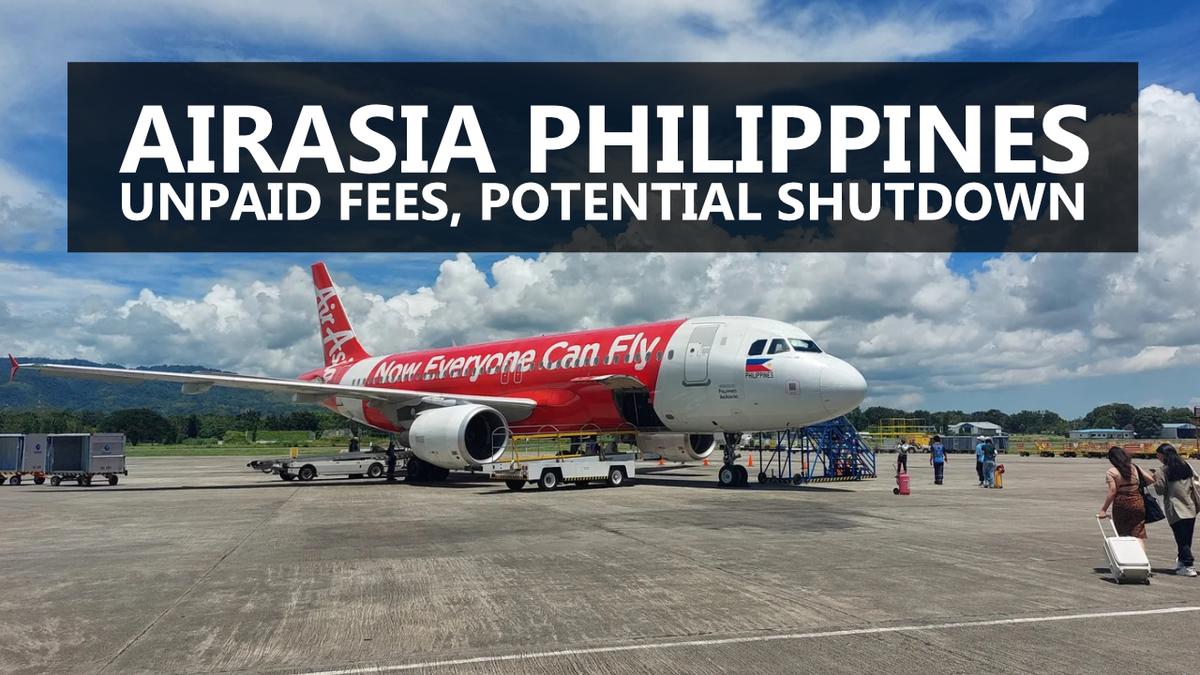
AirAsia Philippines faces the potential of a suspension of its operations due to unpaid fees to the Philippine government.
UPDATE: (June 5, 2026) AirAsia Philippines has settled its financial obligations with the Philippine government. According to the CAAP, the payments were completed as of June 4.
Through AirAsia Philippines, the Malaysia-based AirAsia Group has established itself as a major player in the Philippine aviation industry. Since its first flight in 2012, AirAsia Philippines is now the third biggest airline in the country. While travelers have benefited from AirAsia contributing to lower fares for travel in the Philippines, Philippine aviation regulators are seeking the payment of unpaid obligations by AirAsia Philippines as it faces the potential suspension of its operations. The pressure from the scrutiny from the Philippine government adds to the challenges faced by the Philippine-based AirAsia carrier which has lagged behind the bigger Cebu Pacific and Philippine Airlines in terms of market share in the country.
Unpaid Obligations
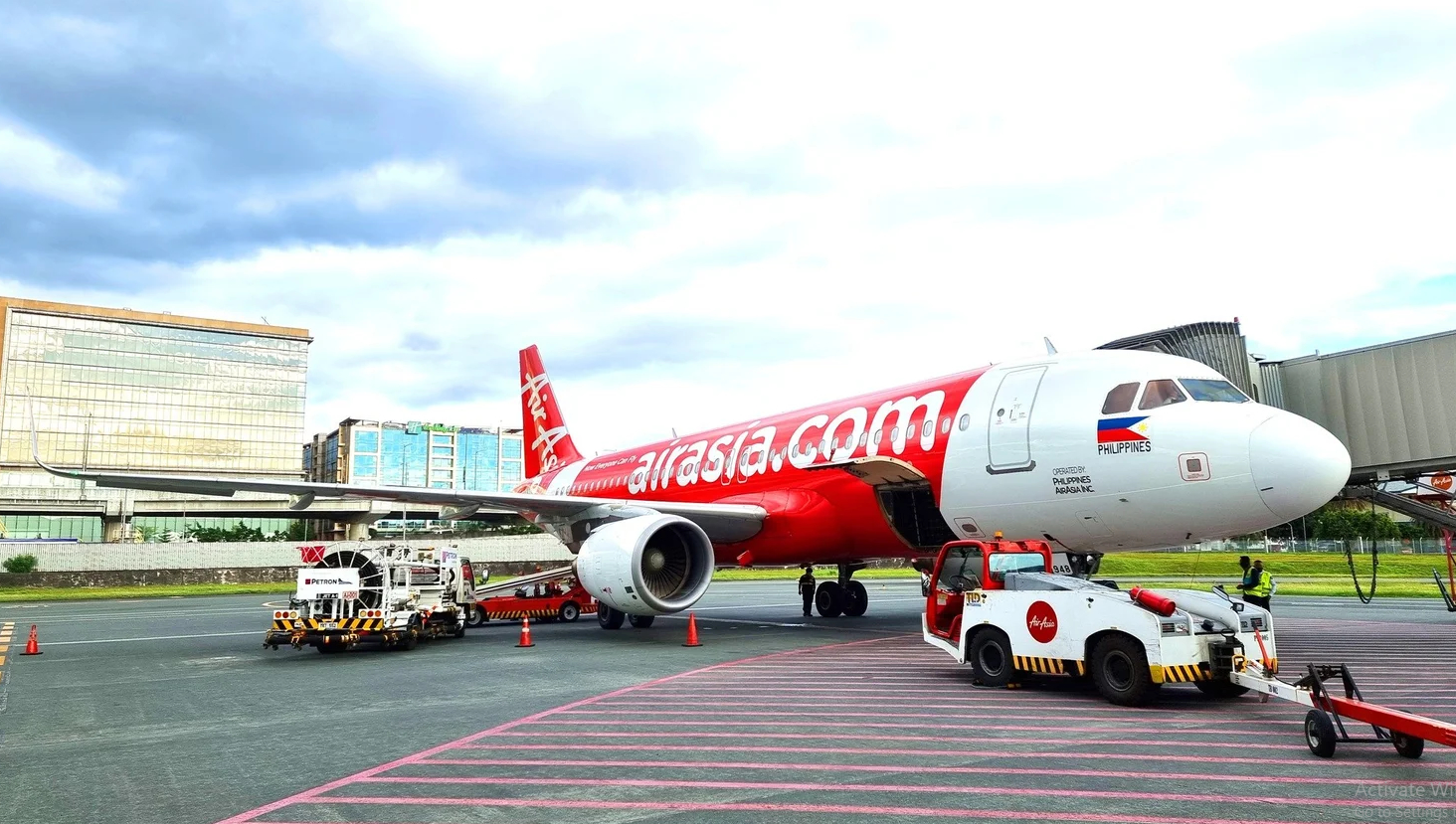
On March 23, 2026 it was reported by InsiderPH that the budget airline had unpaid obligations to the Civil Aviation Authority of the Philippines (CAAP) worth around PHP833.7 million (~USD $13.51 million) at the end of 2025. AirAsia Philippines was given a final demand letter for payment covering air navigation, landing, and parking fees. It also covered unremitted domestic passenger service charges (DPSC) collected from passengers.
The report cited a statement from the CAAP saying: “Despite repeated written demands, reconciliation meetings, and follow-ups, the foregoing obligations remain outstanding as of date. This continued non-compliance is a matter of serious concern to the Authority.”
Based on further reading, it has been a problem the budget airline has faced over the last few years. Amid the pandemic, the CAAP issued a demand letter back in December 15, 2022 for PHP1.14 billion (~USD $18.47 million) worth in unpaid obligations. AirAsia Philippines was able to settle the air navigation charges and concession fees to avoid a shutdown of its operations ahead of the Christmas holiday period at the time.
The recent conflict in the Middle East has only added to AirAsia Philippines’ problems with higher fuel costs and softer demand. Since the issuance of the demand letter on March 23, AirAsia Philippines has been working with the CAAP and reduced its outstanding obligations to around PHP200 million (~USD $3.24 million). However with the passing of the deadline to complete the payments, it has been reported on June 3 that the CAAP issued a letter ordering the airline to complete its payments or have its operations suspended at all Philippine government-run airports by June 6.
According to the most recent reports, AirAsia Philippines’ financial obligations are worth around PHP270 million (~USD $4.3 million).
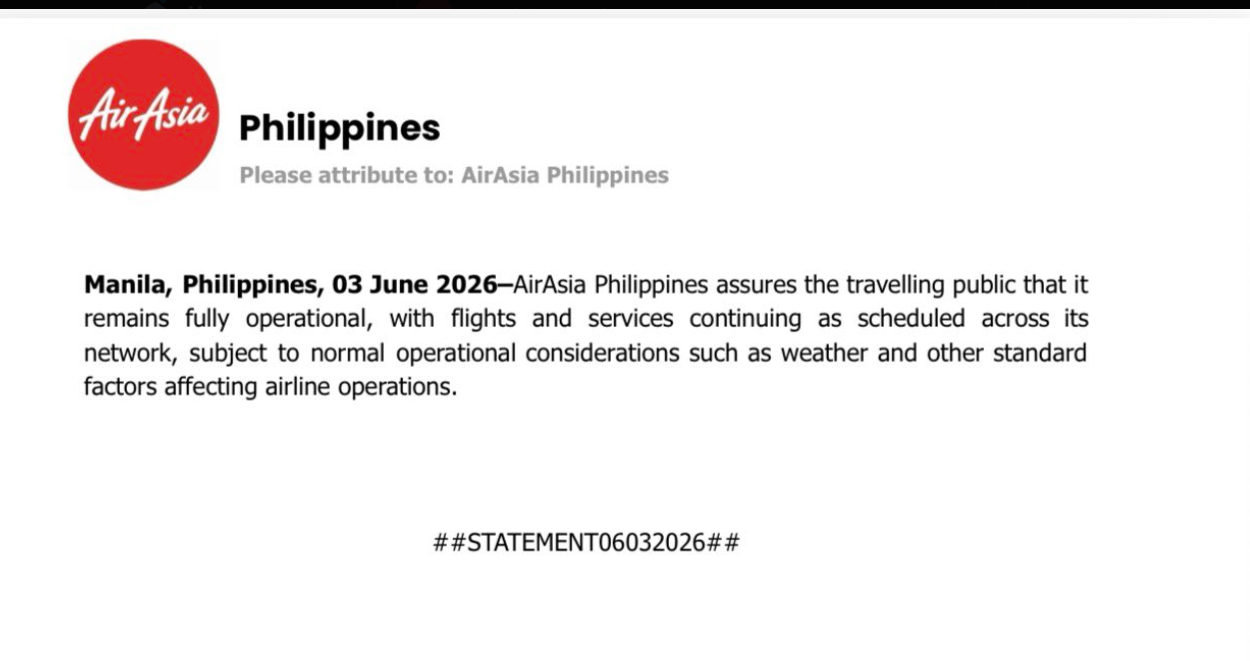
In response to the reports, the airline issued a statement saying: “AirAsia Philippines assures the traveling public that it remains fully operational, with flights and services continuing as scheduled across its network, subject to normal operations considerations such as weather as other standard factors affecting airline operations.”
Slow Post-Pandemic Recovery
It has been a challenge for AirAsia Philippines to increase its share of the market in the Philippines. While Capital A does not disclose the individual airline subsidiaries’ financial statements, the reports of the unpaid financial obligations and the slower post-pandemic recovery are problems that the Philippine-based subsidiary currently faces.
The launch of AirAsia Philippines in 2010 and its first flights 2 years later marked the entry of the Malaysia-based airline group’s presence in the Philippines. Building on the foundation of the former Zest Airways, AirAsia Philippines is now the third biggest airline in the country after Philippine Airlines and Cebu Pacific. While Cebu Pacific introduced low fare travel to the Filipino traveler, AirAsia Philippines’ presence has helped lower airfares even further. However, the airline has also experienced a series of recent setbacks including service reductions and route suspensions.
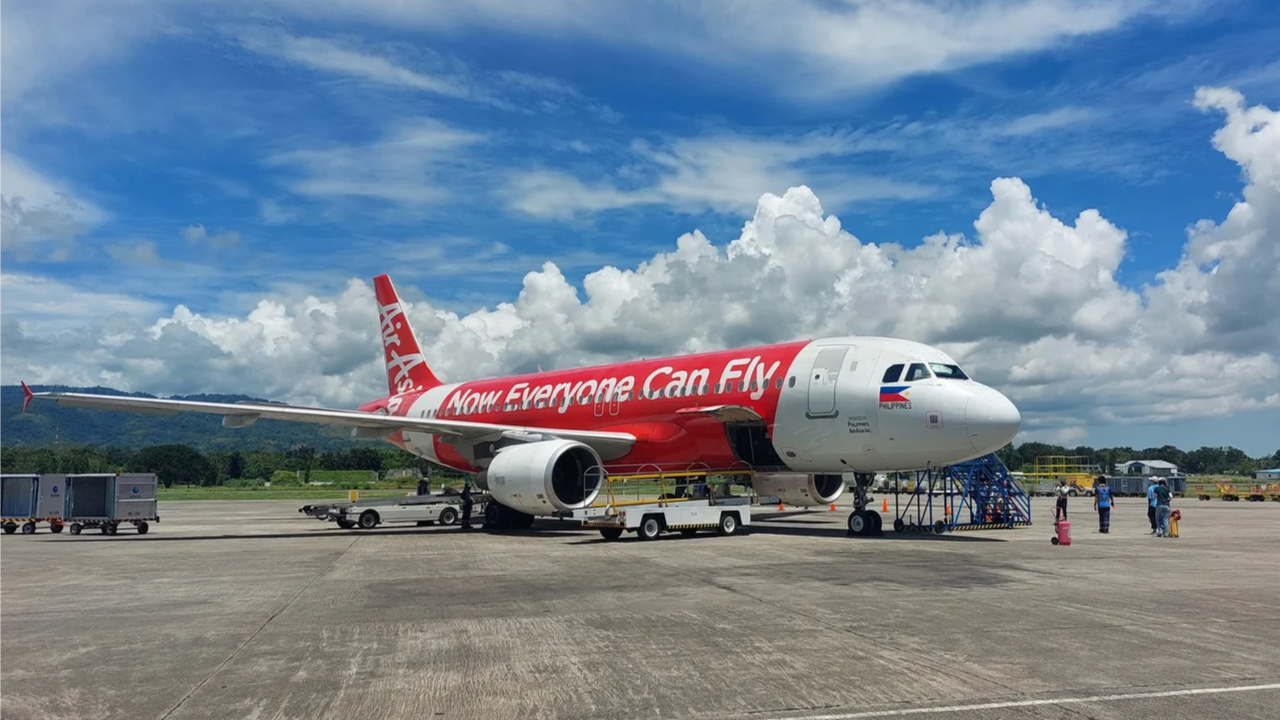
According to planespotters.net, AirAsia Philippines has an active fleet of 13 Airbus A320 aircraft. Meanwhile, 11 jets are currently parked. Within the past year AirAsia Philippines has launched flights from Cebu to both Macao and Kuala Lumpur, and to Hanoi and Da Nang from Manila. However, services has recently been cut from Manila to Tokyo Narita and Seoul Incheon. The biggest shock was its suspension of its flights on the busy Manila-Davao route in January 2025. Services to Davao would later be resumed with a route from Cebu.
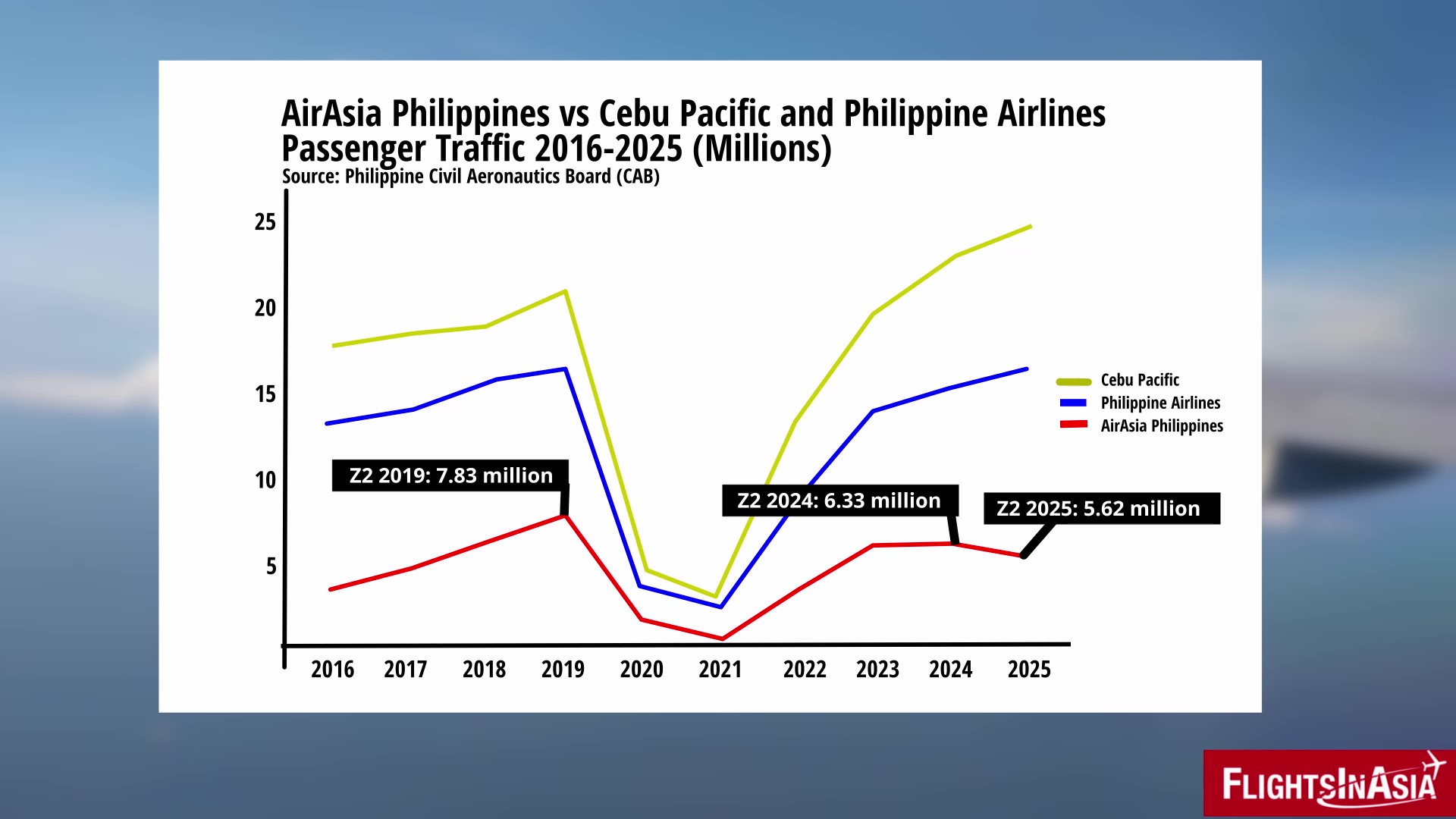
Lagging behind Cebu Pacific and Philippine Airlines in terms of passenger traffic, AirAsia Philippines also has not fully recovered from the COVID-19 pandemic. Based on data from the Philippine Civil Aeronautics Board (CAB), AirAsia Philippines served a record high of 7.83 million passengers in 2019. After recording a post-pandemic high of 6.33 million in 2024 (80% compared to 2019), the airline saw a decrease to 5.62 million last year (72% compared to 2019). In contrast, Cebu Pacific recorded a new passenger traffic record in 2025 of over 24.7 million passengers (118% compared to 2019). Philippine Airlines has nearly matched its pre-pandemic high serving around 16.2 million passengers last year.
Notes:
1. Passenger traffic total of each airline is the sum of domestic and international traffic from CAB
2. Cebu Pacific: Includes Cebu Pacific (5J) and CebGo (DG)
3. Philippine Airlines: Includes Philippine Airlines (PR) and PAL Express (2P)
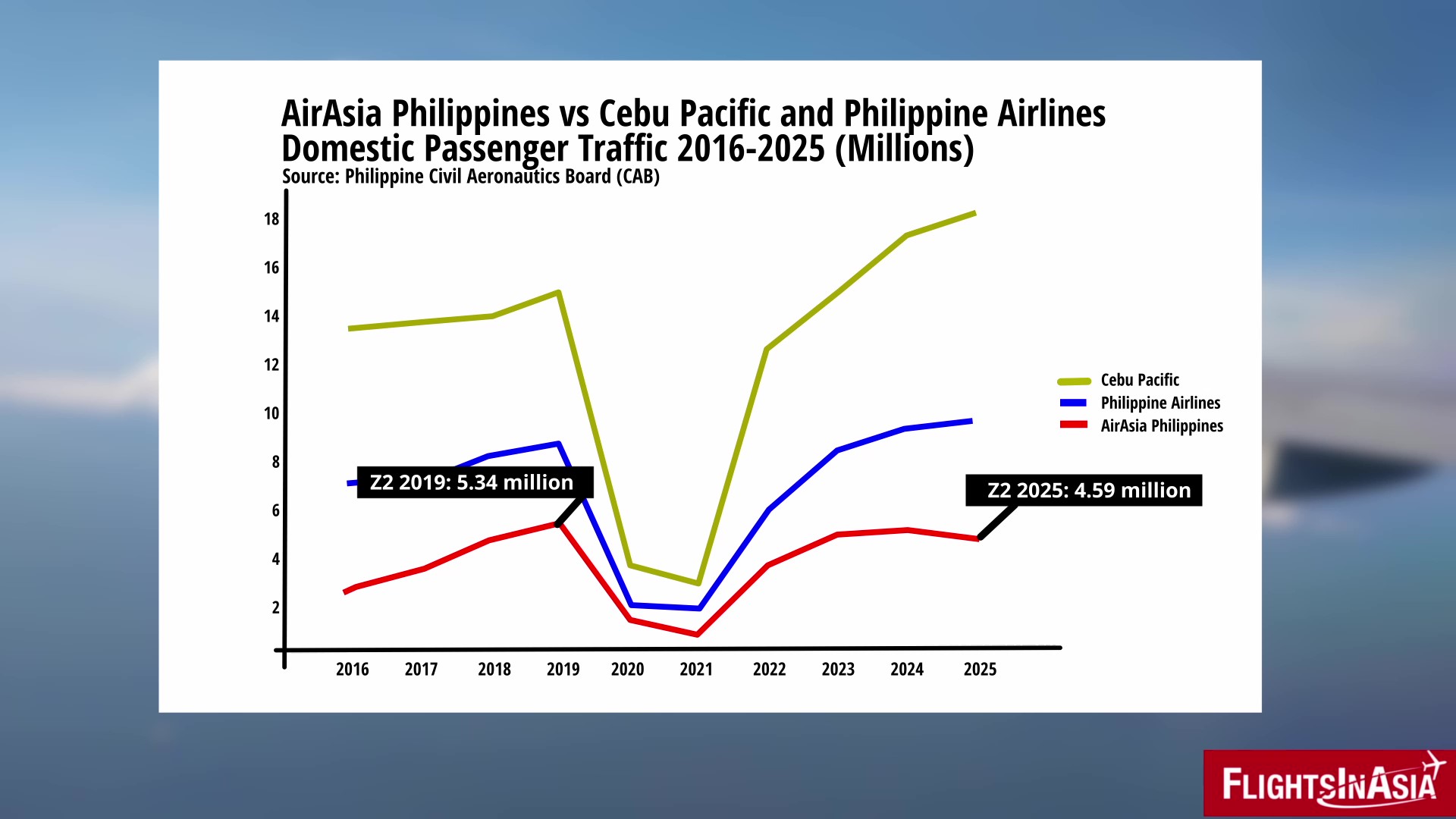
Between its domestic and international passenger traffic, AirAsia Philippines has recovered to around 86% of its pre-pandemic domestic traffic serving 4.59 million passengers last year. This pales in comparison to the 18.2 million domestic passengers served by Cebu Pacific/CebGo and the 9.73 million served by Philippine Airlines/PAL Express, which were new records for each airline.
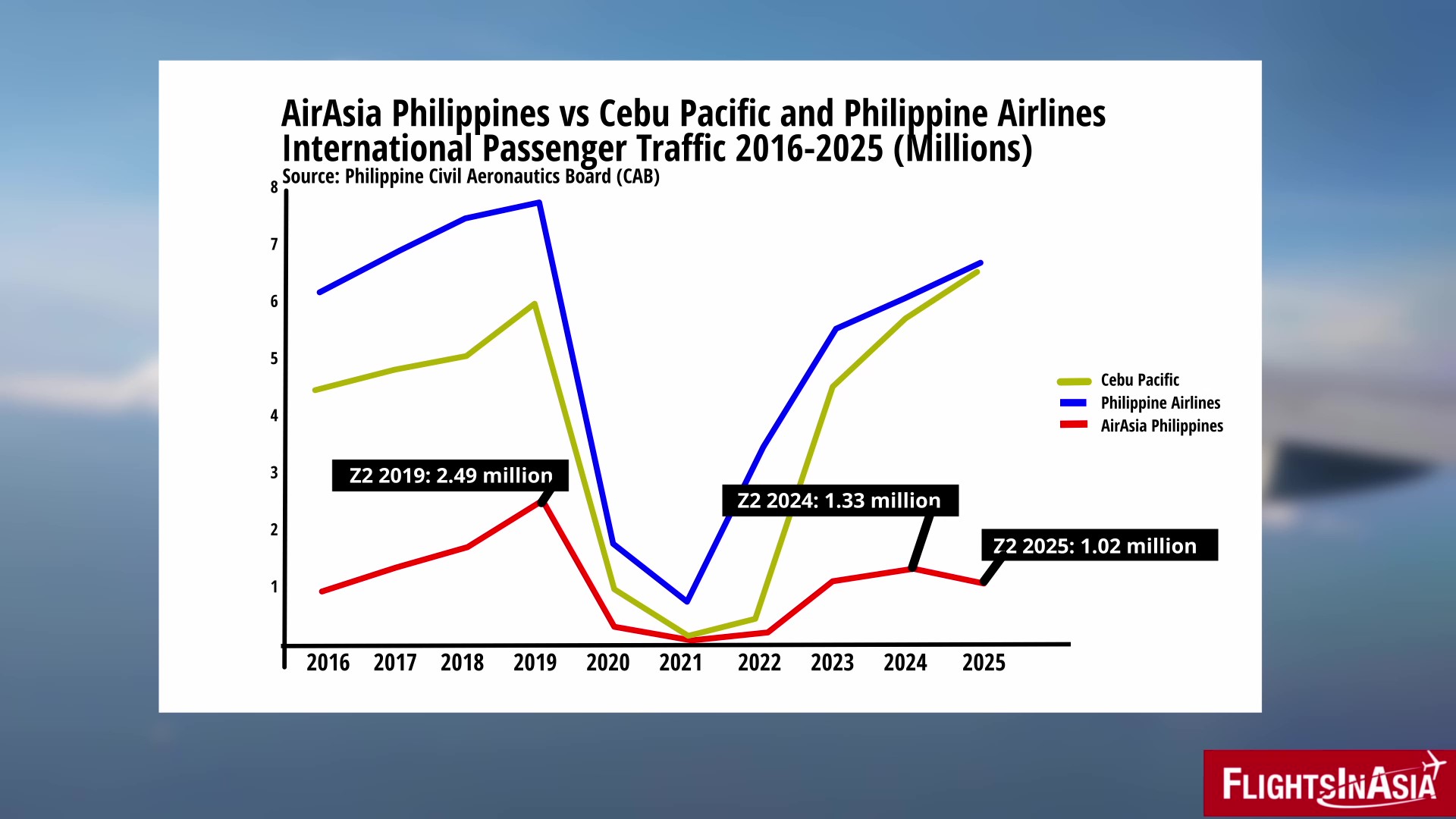
Within the three big Philippine carriers, AirAsia Philippines’ international passenger traffic has been the slowest to recover from the pandemic. AirAsia Philippines served just over 1 million international passengers in 2025. It is 41% - less than half - compared to 2019 when it served a high of over 2.49 million. It is also a decrease from the 1.33 million served in 2024. Philippine Airlines’ international passenger traffic is still recovering from the pandemic (6.54 million in 2025 versus 7.7 million in 2019), while Cebu Pacific has surpassed its pre-pandemic high serving 6.45 million (5.95 million in 2019).
It has been a challenge for AirAsia Philippines to increase its share of the market in the Philippines. While Capital A does not disclose the individual airline subsidiaries’ financial statements, the reports of the unpaid financial obligations and the slower post-pandemic recovery are problems that the Philippine-based subsidiary currently faces.
While AirAsia Philippines was working to establish its presence in the Philippines in the 2010s, Cebu Pacific and Philippine Airlines opened up more point-to-point travel within the Philippines beyond Manila. The two bigger airlines have developed their domestic networks beyond Manila with multiple hubs within the country including Cebu, Davao, Iloilo, and Clark. AirAsia’s all-A320 fleet has also limited the growth of the domestic network. The narrowbody jets can’t operate at smaller airfields that travelers use to reach popular tourist attractions such as Siargao and El Nido.
AirAsia Philippines has also been affected by outside factors affecting its international network, and entered itself into highly competitive markets. Mainland China was once a strong market for the budget airline, but that market has since been affected by geopolitical tensions and a decline in Chinese tourism to the Philippines. The airline also had flights to cities in South Korea and Japan from Manila and Cebu. While those routes such as to Tokyo Narita, Osaka Kansai and Seoul Incheon had fewer competing airlines, the budget airlines operating on the route provide very tough competition.
Leverage the AirAsia Brand
AirAsia Philippines must first address its immediate problems and resolve its situation with the Philippine government. Then it can start to work to improve the experiences for its customers in the Philippines to better compete with Philippine Airlines and Cebu Pacific.
Before addressing its current position in the Philippine market, AirAsia Philippines has to resolve its financial obligations to the Philippine government. While the Philippine-based subsidiary has reduced the amount to around PHP270 million, they may need further assistance from the parent company in Malaysia to pay off the remaining amount. Any disruption of its operations would have a detrimental effect on the overall aviation industry in the Philippines. That could be the reason why the CAAP has allowed AirAsia Philippines to continue operations while working to resolve the situation much to the ire of the aviation regulator.
With the smallest fleet and current network it is understandable the Philippine-based AirAsia airline will not overtake either of the two bigger competitors in the immediate future. While waiting for AirAsia to bring in new aircraft to expand and replace its aging fleet of A320s, the Philippine-based subsidiary will need to continue to build its domestic network which could include hubs outside of Manila.
While backed by the AirAsia brand, I do think the airline needs to improve its image in the eyes of the Filipino traveler. One can see reviews on websites such as tripadvisor.com for AirAsia Philippines which is filled with a mix of good and bad experiences. Common customer complaints include long delays combined with a lack of communication regarding the delays, as well as poor customer service. Reviews on third-party sites such as tripadvisor should be verified, though one can see a recurring pattern of frustration after flying with the airline. AirAsia Philippines can look to improve the passenger experience to make it more attractive for Filipinos to fly with them.
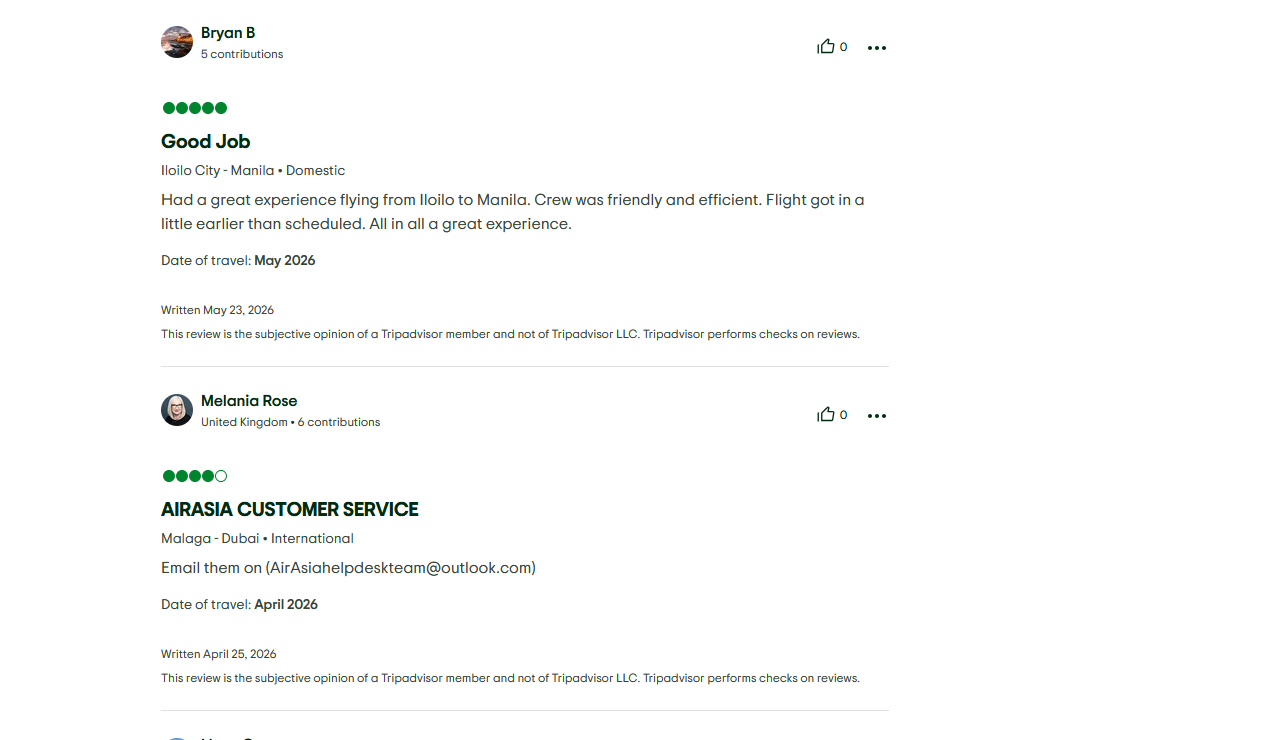
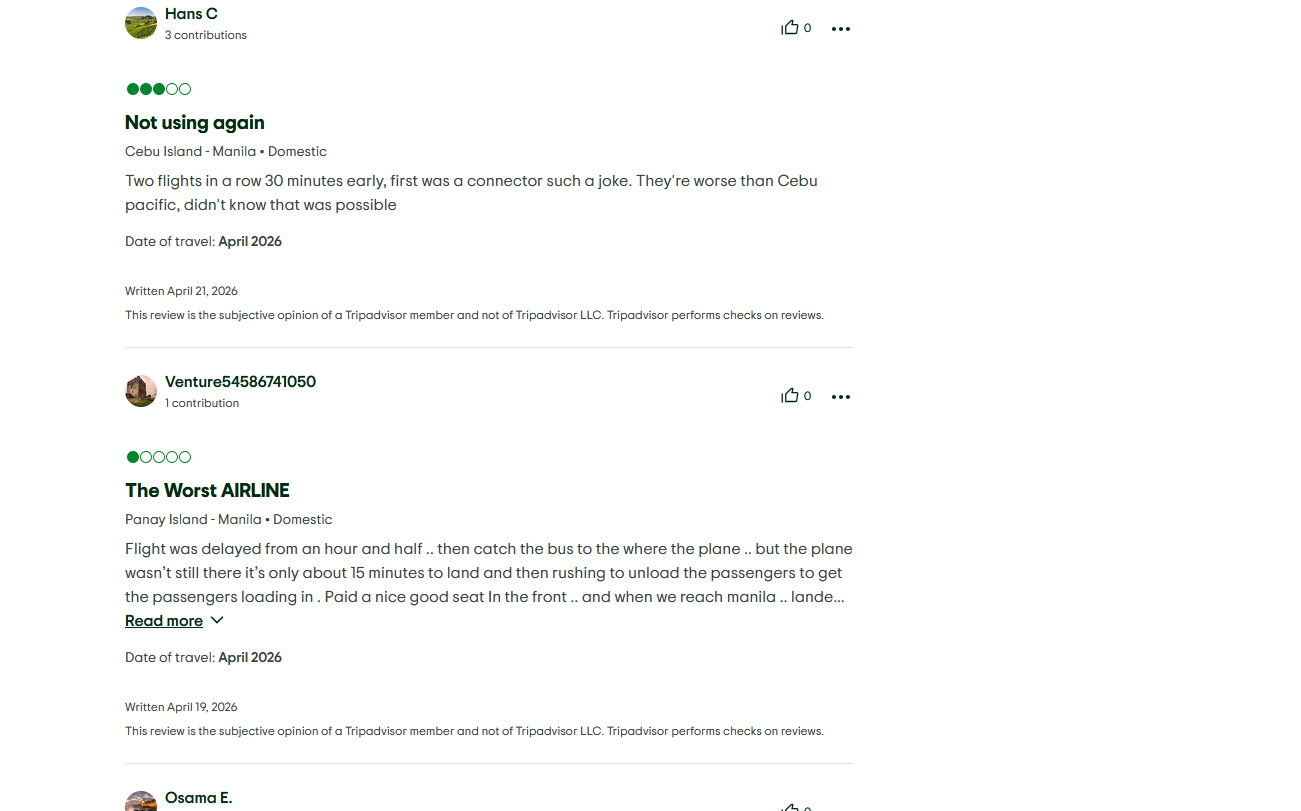
Screenshots of personal reviews by AirAsia Philippines' customers on Tripadvisor. Note that the reviews are written by Tripadvisor members and not the opinions of Tripadvisor or Flights in Asia.
Beyond the Philippines, the current way to contact AirAsia’s customer support services is via the automated assistant on the website. I have personally used the bot following a flight cancellation to request a refund. Based on my own personal experience, I would recommend that there should be a way to talk to a human. I understand that it has been automated to reduce the workload of handling the many customer service requests they get, but a real interaction between the customer and an airline representative is also needed especially for a business that serves real people such as an airline.
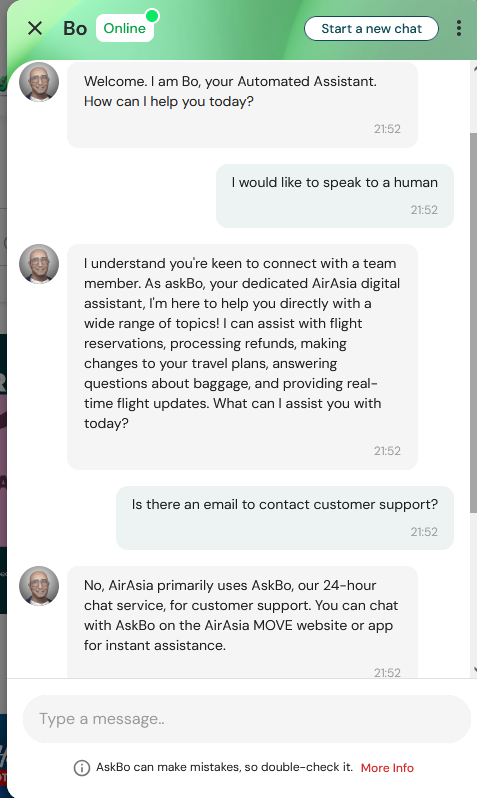
A screenshot of an interaction with AirAsia's automated bot on the airasia.com
Despite its challenges in the Philippines, AirAsia is arguably the biggest brand name to come from Southeast Asia. Customers can book their travel on the main website, which can also include connections to other destinations across the group’s network via Kuala Lumpur and Bangkok Don Mueang. Each subsidiary will also get support from AirAsia’s main headquarters in Malaysia with the group’s investments in new, fuel efficient aircraft over the next few years. However, AirAsia Philippines must first address its immediate problems and resolve its situation with the Philippine government. Then it can start to work to improve the experiences for its customers in the Philippines to better compete with Philippine Airlines and Cebu Pacific.